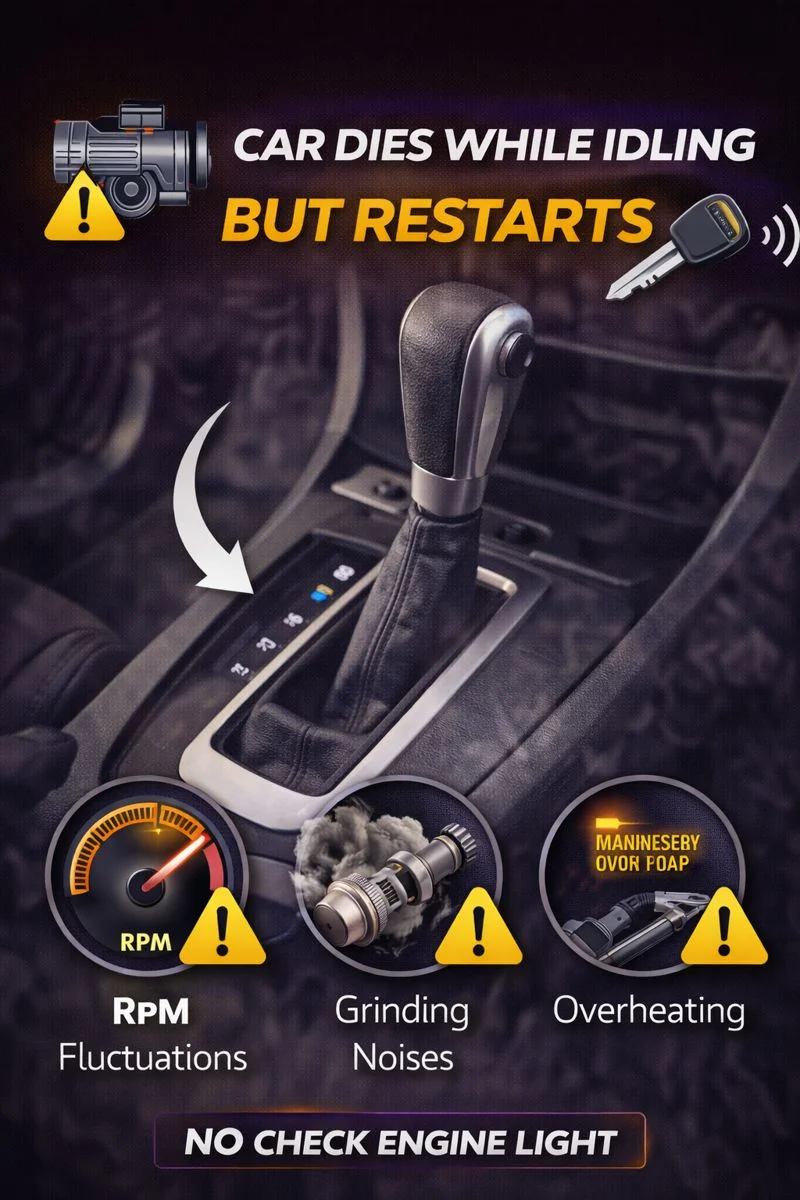
A car that shuts off while idling and then restarts without trouble can feel more confusing than a complete breakdown. There is no warning light, no clear error message, and no obvious pattern at first. It may happen at a red light, while waiting in a parking lot, or just after starting the engine.
Once the engine restarts, everything seems normal again, which makes the problem easy to dismiss. Many drivers continue driving for weeks or months, hoping it was a one-time issue.
The absence of a check engine light often creates a false sense of security. In reality, modern engines can stall without triggering a fault code, especially when the issue is intermittent or mechanical rather than electronic.
Idling is the most delicate operating state for an engine. Small problems that go unnoticed at speed can cause the engine to shut down quietly when it is sitting still. You should know why this happens and what systems are involved helps prevent repeated stalling and avoids being caught off guard in traffic.
Why Idling Is The Most Sensitive Engine Condition
At idle, the engine runs at its lowest speed and produces minimal power. There is very little margin for error. Airflow is limited, fuel delivery is precise, and the engine relies heavily on sensors and control systems to stay running.
When driving, engine momentum helps smooth out small issues. At idle, that cushion disappears. A slight airflow restriction, a brief sensor glitch, or a small drop in voltage can cause the engine speed to fall below the point where it can sustain combustion.
This is why many cars stall only at idle and nowhere else.
What It Means When There Is No Check Engine Light
The check engine light turns on when the engine computer detects a fault that meets specific criteria. Not all problems meet those criteria.
Some issues are mechanical rather than electronic. Others occur too briefly to be logged as a fault. In some cases, the engine shuts off before the computer can fully detect and store the problem.
A lack of warning light does not mean nothing is wrong. It often means the issue is subtle, intermittent, or outside the range of monitored parameters.
Airflow Problems That Cause Idle Stalling
Airflow control is one of the most common causes of stalling at idle with no warning light.
The throttle body regulates how much air enters the engine. Over time, carbon buildup forms around the throttle plate. At idle, the plate is nearly closed, so even small deposits can restrict airflow enough to stall the engine.
Idle air control systems manage airflow when the throttle is closed. If the control valve sticks or reacts slowly, the engine may not receive enough air to stay running.
Vacuum leaks are another frequent cause. Cracked hoses, loose fittings, or failing gaskets allow unmetered air into the engine. At idle, this disrupts the air-fuel balance more severely than at higher speeds.
These issues often do not trigger a check engine light, especially in early stages.
Fuel Delivery Issues That Appear Only At Idle
Fuel delivery must be extremely consistent at idle. Small irregularities can cause stalling.
Dirty fuel injectors may deliver uneven fuel at low flow rates. While the engine can compensate at higher speeds, idle operation suffers.
A weak fuel pump may still supply enough pressure for cruising but struggle at low speed, especially when additional load is introduced.
Fuel pressure regulators that respond slowly can also cause brief fuel starvation at idle.
Because fuel delivery may recover instantly, the engine restarts easily and leaves no stored fault code.
Sensors That Can Stall An Engine Without A Warning Light
Several sensors play a major role in idle control, and failures do not always trigger alerts.
The mass airflow sensor measures incoming air. If it becomes dirty or inaccurate, the engine computer may miscalculate fuel needs at idle.
The throttle position sensor informs the system how open the throttle is. Incorrect readings can confuse idle control logic.
The engine coolant temperature sensor determines fuel mixture based on engine temperature. If it reports incorrect data, the engine may not receive the proper mixture at idle.
Crankshaft and camshaft position sensors can momentarily lose signal. Even a brief interruption can cause the engine to shut off. If the signal returns quickly, the engine restarts without logging a fault.
Electrical And Voltage Stability Problems
Electrical stability is critical at idle.
At low engine speed, alternator output is reduced. If the battery is weak or connections are poor, voltage can dip just enough to disrupt engine control systems.
Loose or corroded ground connections are especially problematic. They cause intermittent voltage drops that affect sensors and control modules.
These issues rarely trigger warning lights and often appear random, making them difficult to diagnose.
Load Changes That Push Idle Past Its Limit
Idle speed must increase slightly when additional load is applied.
Turning on air conditioning, headlights, or power steering increases engine load. If the engine cannot compensate quickly enough, it may stall.
This often happens when stopping, turning the steering wheel at low speed, or shifting into gear.
Faulty load compensation systems do not always generate fault codes, especially if the stall happens quickly.
Transmission And Drivetrain Factors
Some idle stalls occur when shifting into gear.
If idle speed is set too low, engaging the transmission adds enough load to stall the engine.
Torque converter issues in automatic transmissions can also contribute. If the converter does not release properly at idle, it drags the engine speed down.
Transmission-related stalls often feel abrupt and may happen without any warning indicators.
Exhaust And Emissions Components That Affect Idle
Exhaust-related problems can also cause stalling.
A stuck-open exhaust gas recirculation system introduces exhaust gases at idle when they are not needed. This disrupts combustion and causes stalling.
Partially clogged exhaust components may restrict flow just enough to affect idle stability without causing noticeable power loss at speed.
These issues may not trigger a check engine light immediately.
Why The Engine Restarts So Easily
Restarting the engine temporarily resets several systems.
Airflow changes during cranking, fuel delivery enriches briefly, and sensors reinitialize. This allows the engine to run again, masking the underlying problem.
As the engine returns to idle conditions, the issue may repeat.
This cycle explains why stalling can happen multiple times without obvious escalation at first.
How Idle Stalling Usually Progresses
Idle stalling rarely resolves on its own.
What starts as an occasional stall often becomes more frequent. The engine may stall more quickly, restart less smoothly, or begin stalling during deceleration.
Over time, the issue may expand into rough running, poor fuel economy, or warning lights.
Addressing the problem early prevents this progression.
Practical Observations That Help Identify The Cause
Pay attention to patterns.
Does the stall occur only when warm? Only with accessories on? Only when shifting into gear?
Does idle speed fluctuate before stalling? Does the engine stumble or shut off suddenly?
These details help narrow down whether the issue is airflow, fuel, electrical, or load-related.
Even without a check engine light, scanning for stored or pending codes can reveal useful clues.
Common Fixes That Restore Stable Idle
Throttle body cleaning resolves many idle stalling issues.
Repairing vacuum leaks restores proper airflow balance.
Cleaning or servicing fuel injectors improves consistency at idle.
Replacing weak batteries or fixing ground connections stabilizes voltage.
Addressing sensor issues restores accurate engine control.
Transmission-related adjustments or repairs correct load-related stalls.
The correct fix depends on identifying the root cause rather than guessing.
Why Random Parts Replacement Rarely Works
Idle stalling involves multiple interacting systems.
Replacing parts without diagnosis often fails because the real issue remains.
Accurate diagnosis focuses on behavior patterns, data, and physical inspection rather than assumptions.
When Idle Stalling Becomes A Safety Concern
Stalling in traffic, intersections, or parking maneuvers can be dangerous.
Loss of power steering or brake assist, even briefly, increases risk.
If stalling becomes frequent or unpredictable, driving should be limited until resolved.
Preventing Idle Stalling Problems
Regular maintenance keeps airflow and fuel systems clean.
Battery and electrical inspections prevent voltage-related issues.
Addressing small drivability changes early prevents escalation.
Ignoring early symptoms almost always leads to worse problems.
Final Thoughts
A car that dies while idling but restarts easily with no check engine light is sending a quiet warning. The engine is struggling to maintain balance under its most sensitive operating condition. While the absence of a warning light makes the issue harder to trust, it does not make it harmless.
Most causes are manageable when addressed early. Paying attention to patterns, resisting the urge to guess, and focusing on idle-specific systems lead to accurate diagnosis and lasting repair. Restoring a stable idle does more than prevent stalling—it brings back confidence that the engine will keep running when you need it most.