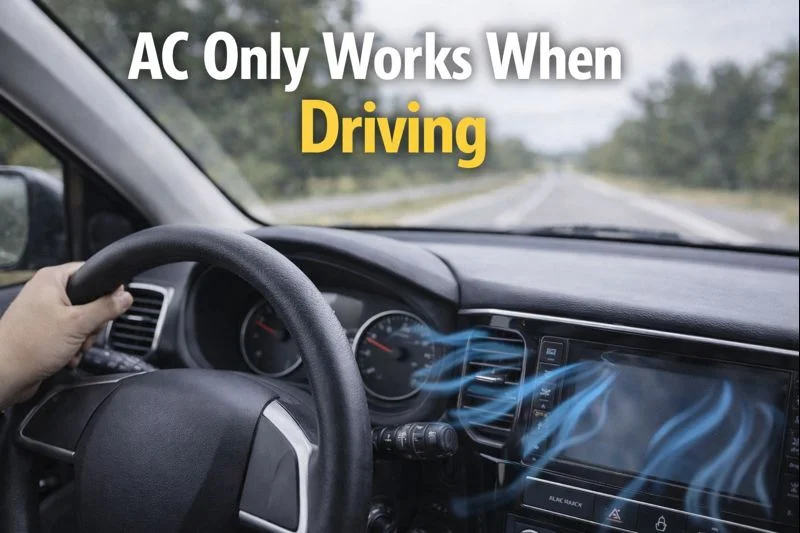
Air conditioning is supposed to deliver consistent cooling whether the car is moving or sitting still. When cold air appears only while driving and fades or disappears at idle, it creates confusion and discomfort, especially in traffic or at stoplights.
This behavior is not random, and it is rarely caused by a single part failing overnight. Instead, it usually reflects how the cooling system responds to airflow, engine speed, pressure changes, and heat buildup.
Many drivers assume low refrigerant is always to blame, but that is only one piece of a much larger picture. The air conditioning system depends on several components working together, and some of them perform very differently at idle compared to higher speeds.
When something is weak, partially restricted, or aging, the system may cope while driving but struggle when stationary. This article explains why AC may only work when driving in a clear, practical way.
It covers how the system behaves, which components are involved, what each failure means, and how to approach repairs logically. By understanding the cause instead of guessing, the problem becomes solvable rather than frustrating.
How Automotive AC Cooling Is Supposed To Work
An automotive air conditioning system removes heat from inside the cabin and releases it outside. Refrigerant circulates through the system, changing pressure and temperature as it moves.
The compressor pressurizes the refrigerant, the condenser releases heat, the expansion device lowers pressure, and the evaporator absorbs cabin heat. Fans and airflow support this process.
When all components operate correctly, cooling remains consistent regardless of vehicle speed. Any loss of cooling at idle indicates a breakdown in heat removal or pressure control.
Why Vehicle Speed Changes Cooling Behavior
Driving speed affects airflow and engine speed. Both factors directly influence AC performance.
At higher speeds, air flows naturally across the condenser. Engine speed increases compressor output. Electrical systems receive stable voltage.
At idle, airflow depends entirely on cooling fans, and compressor speed drops. Weak components often reveal themselves under these conditions.
This is why AC problems frequently show up when stopped.
Insufficient Condenser Airflow
The most common cause of AC working only while driving is poor airflow across the condenser.
The condenser sits at the front of the vehicle and relies on airflow to release heat. When driving, air passes through naturally. At idle, electric fans must do all the work.
If a cooling fan is weak, slow, or not engaging, heat builds up quickly. Refrigerant pressure rises, and cooling drops.
Cooling Fan Failure Or Reduced Performance
Cooling fans may fail completely or partially. A fan that spins slowly or intermittently can appear functional but still be ineffective.
Worn motors, failing relays, weak electrical connections, or faulty temperature sensors can all reduce fan performance.
When the fan cannot remove heat at idle, AC output becomes warm even though it cools while moving.
Dirty Or Blocked Condenser Fins
Condenser fins are thin and easily clogged by dirt, bugs, leaves, and road debris.
Restricted fins reduce heat transfer efficiency. At speed, airflow may compensate. At idle, reduced airflow becomes critical.
Even partial blockage can cause pressure buildup and cooling loss when stationary.
Low Refrigerant Charge And Idle Performance
Low refrigerant levels often cause weak cooling at idle first.
At higher engine speeds, the compressor may still generate enough pressure difference to cool. At idle, pressure drops too low to support effective heat transfer.
Low refrigerant is usually caused by small leaks that develop gradually over time.
Why Low Refrigerant Shows Up At Stoplights
Refrigerant absorbs heat in the evaporator. If there is not enough refrigerant, heat absorption becomes inconsistent.
At idle, slower compressor speed reduces circulation further.
This combination results in cooling only when engine speed increases during driving.
Compressor Wear And Reduced Efficiency
Compressors wear internally over time. Worn internal seals reduce pumping efficiency.
At higher RPM, the compressor may still move enough refrigerant to cool. At idle, output may be too weak.
This failure often progresses slowly and may not trigger warning signs immediately.
Variable Displacement Compressor Behavior
Many modern vehicles use variable displacement compressors that adjust output automatically.
When internal control mechanisms fail, the compressor may not increase output at idle as needed.
This causes cooling to drop at stops while appearing normal at speed.
AC Pressure Sensor And Control Issues
Pressure sensors monitor system conditions and protect components.
Faulty sensors may report incorrect values, causing the system to reduce compressor operation unnecessarily at idle.
This results in intermittent or speed-dependent cooling behavior.
Electrical Voltage Drops At Idle
At idle, electrical voltage is lower than while driving. Weak batteries or failing alternators may struggle to support all systems.
AC compressors, fans, and control modules rely on stable voltage.
Voltage drops may prevent fans or compressors from operating at full capacity when stopped.
Engine Temperature Influence On AC Performance
Engine heat increases while idling, especially in hot weather.
If engine cooling is marginal, the AC system may be partially shut down to protect the engine.
This often causes warm air at stops and cold air while moving.
Radiator And AC System Heat Interaction
The radiator and condenser share airflow space. When engine cooling struggles, heat builds up in front of the condenser.
This reduces the condenser’s ability to release heat.
As a result, AC performance drops when stationary.
Overcharged AC Systems
Too much refrigerant can cause high pressure at idle.
At speed, airflow may manage excess heat. At idle, pressure rises too high, reducing cooling.
Overcharging is just as harmful as undercharging and often overlooked.
Expansion Valve Or Orifice Tube Restrictions
The expansion device regulates refrigerant flow.
Partial blockages may allow sufficient flow at speed but restrict flow at idle.
This imbalance causes inconsistent cooling depending on engine RPM.
Moisture Contamination Inside The System
Moisture inside the AC system can freeze at the expansion point.
At idle, freezing may block refrigerant flow. At speed, pressure changes may temporarily clear it.
This cycle leads to inconsistent cooling patterns.
Cabin Airflow And Blend Door Issues
Cooling may be produced correctly but not delivered properly.
Blend door motors may change position slightly with engine vibration or electrical changes.
At idle, airflow may be diverted incorrectly, reducing cold air delivery.
Idle Speed And Engine Load Factors
Low idle speed reduces compressor output.
Some vehicles compensate automatically, but others struggle if idle control is weak.
Heavy electrical load at idle further reduces system performance.
Why Traffic Makes The Problem Obvious
Traffic creates the perfect conditions for failure: high heat, low airflow, low engine speed.
This exposes weaknesses that remain hidden during highway driving.
Understanding this pattern helps narrow down causes quickly.
Diagnostic Clues That Help Identify The Cause
Cooling returns immediately when moving points toward airflow or fan issues.
Gradual cooling loss suggests pressure or refrigerant problems.
Intermittent behavior often indicates electrical or sensor issues.
Observing patterns provides valuable diagnostic insight.
Simple Checks That Can Be Done First
Listen for cooling fans engaging when AC is on.
Check for visible debris in front of the condenser.
Monitor engine temperature during idle.
These observations guide further diagnosis.
Why Ignoring The Issue Makes It Worse
Heat stress damages AC components over time.
High pressure shortens compressor life.
What starts as an airflow issue can become a full system failure.
Repair Costs And Complexity Range
Fan repairs are often straightforward.
Refrigerant leaks vary in cost depending on location.
Compressor replacement is more expensive but sometimes unavoidable.
Early diagnosis saves money.
Preventive Maintenance That Helps Avoid This Issue
Keeping the condenser clean improves airflow.
Addressing cooling fan issues early protects the system.
Regular AC inspections catch refrigerant loss before performance drops.
Misconceptions About AC Behavior At Idle
Many assume AC always weakens at idle. Properly functioning systems do not.
Another misconception is that refrigerant recharge always fixes the problem.
Understanding the system prevents unnecessary repairs.
When Professional Diagnosis Is Necessary
Modern systems rely on sensors and electronic controls.
Pressure readings and scan data reveal underlying issues.
Professional diagnosis prevents guesswork.
Environmental And Driving Condition Influence
Extreme heat worsens marginal systems.
Stop-and-go driving stresses airflow-dependent components.
Vehicle design also plays a role.
Long-Term Impact On Comfort And Reliability
Unreliable AC reduces comfort and increases driver fatigue.
Ignoring early signs leads to expensive repairs.
Proper cooling supports overall vehicle health.
Why This Problem Is Common In Older Vehicles
Age increases wear on fans, compressors, and seals.
Electrical connections degrade over time.
Older systems struggle more at idle due to accumulated wear.
Understanding The System Prevents Panic
Speed-dependent cooling feels alarming but follows logical patterns.
Identifying airflow, pressure, or electrical limits clarifies the issue.
Knowledge replaces frustration with control.
Final Thoughts
When AC only works while driving, the system is signaling a weakness that appears under low airflow or low engine speed. Whether caused by cooling fan issues, refrigerant imbalance, compressor wear, or electrical limitations, the behavior is predictable and diagnosable.
Addressing the root cause restores consistent cooling and prevents long-term damage. Instead of assuming the worst, understanding how the system responds at idle allows targeted repairs and lasting comfort. A properly functioning AC system should cool just as effectively at a stoplight as it does on the highway, and restoring that balance is both achievable and worthwhile.