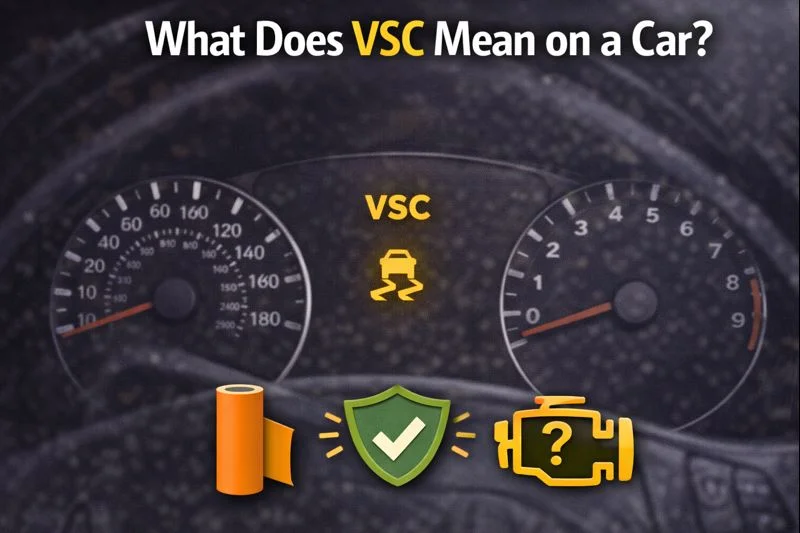
Modern vehicles rely on advanced electronic systems to improve stability, traction, and overall safety. Among the warning lights that sometimes appear on the dashboard, one of the most common is labeled “VSC.” Many drivers notice it illuminate unexpectedly and are unsure what it represents or whether it signals a serious issue.
VSC stands for Vehicle Stability Control. It is designed to help maintain control during sharp turns, slippery road conditions, or sudden steering maneuvers. Unlike older cars that relied purely on mechanical grip, today’s vehicles use sensors and electronic braking adjustments to prevent skidding.
When the VSC light turns on, it may indicate temporary system activation or a fault that requires inspection. Knowing what the system does, how it operates, and what triggers the warning light helps drivers respond appropriately rather than panic or ignore the alert.
What Vehicle Stability Control Actually Does
How The System Monitors Traction And Direction
Vehicle Stability Control continuously monitors how the car moves compared to how the driver intends it to move. Sensors measure steering angle, wheel speed, lateral acceleration, and yaw rate. These inputs allow the control module to detect whether the vehicle is beginning to slide or lose grip.
For example, when turning sharply on a wet road, the rear of the vehicle may begin to drift outward. The VSC system senses this deviation almost instantly. It then selectively applies braking to individual wheels to correct the vehicle’s path.
This intervention often occurs so quickly that the driver may only notice a brief flicker of the VSC light. The system works quietly in the background to keep the vehicle aligned with steering input.
Difference Between VSC And Traction Control
Many drivers confuse VSC with traction control. While related, they serve slightly different purposes. Traction control primarily prevents wheel spin during acceleration, especially on slippery surfaces. It reduces engine power or applies brake force to spinning wheels.
Vehicle Stability Control focuses more on directional stability. It manages oversteer and understeer situations during cornering. Both systems often work together, but VSC addresses broader stability concerns beyond simple acceleration grip.
Understanding this distinction helps clarify why the VSC light may activate during cornering rather than straight-line acceleration.
Why The VSC Light Turns On
Normal Activation During Slippery Conditions
It is completely normal for the VSC light to blink briefly when the system is actively correcting wheel slip. Snow, rain, gravel, or sudden evasive maneuvers can trigger temporary activation.
In these cases, the light usually flashes and then turns off once stability is restored. This behavior indicates the system is functioning properly rather than signaling a malfunction.
Drivers may feel slight braking pulses or reduced engine power during activation. These are part of the system’s correction process.
Persistent Illumination Indicates A Fault
If the VSC light remains on continuously, it typically signals a system fault. The control module may have detected an issue with one of its sensors or related components.
Common triggers include faulty wheel speed sensors, steering angle sensor misalignment, brake system irregularities, or engine-related trouble codes. In some vehicles, an illuminated check engine light automatically disables VSC functionality as a precaution.
When the light stays on, scanning the vehicle for diagnostic trouble codes becomes essential for accurate repair.
Common Causes Of VSC System Malfunctions
Wheel Speed Sensor Failure
Wheel speed sensors monitor rotation at each wheel. These sensors feed real-time data into the stability control system.
If one sensor fails or becomes contaminated with debris, the system may receive inconsistent information. This discrepancy triggers the VSC warning light and disables stability corrections until the issue is resolved.
Replacing a faulty sensor generally restores proper function and clears the warning once codes are reset.
Steering Angle Sensor Calibration Issues
The steering angle sensor measures the position of the steering wheel relative to the wheels. If the sensor loses calibration due to battery disconnection, alignment work, or impact, the system may interpret steering input incorrectly.
Recalibration using diagnostic tools often resolves the issue without replacing components.
Ignoring miscalibration may reduce stability control accuracy.
Engine Related Problems That Trigger VSC
In some vehicles, particularly certain Toyota and Lexus models, engine trouble codes automatically disable VSC.
For example, a loose fuel cap causing an evaporative emissions code may illuminate both the check engine light and the VSC light simultaneously.
This does not necessarily mean the stability system itself has failed. Instead, it indicates a broader engine management issue requiring attention.
Driving With The VSC Light On
Safety Considerations
When the VSC light remains on steadily, the vehicle’s stability control feature may be disabled. The car will still operate normally under regular conditions, but electronic assistance during skidding events may not be available.
Drivers should exercise extra caution in wet or icy conditions. Without stability control, sudden steering corrections can increase the risk of loss of control.
Addressing the issue promptly restores full safety capability.
When Immediate Attention Is Necessary
If the VSC light appears alongside warning indicators such as ABS or brake system alerts, professional inspection becomes urgent.
Brake system faults directly impact stability control performance. Delaying repairs may compromise vehicle safety systems.
Timely diagnosis prevents small electronic faults from escalating into larger mechanical issues.
How The VSC System Integrates With Other Safety Features
Relationship With ABS And Brake Assist
Vehicle Stability Control works closely with Anti-Lock Braking Systems. ABS prevents wheel lockup during heavy braking, while VSC manages directional stability.
When correcting a skid, VSC applies brake force through the ABS system. This coordinated effort ensures smooth correction without locking wheels.
Brake assist systems further enhance stopping power in emergency situations.
These technologies combine to create layered safety support.
Electronic Throttle And Engine Power Reduction
In addition to applying brakes selectively, VSC may reduce engine power temporarily. This prevents excessive acceleration during unstable conditions.
Throttle reduction helps stabilize the vehicle when wheels lose grip.
Drivers may notice slight hesitation during aggressive maneuvers. This intervention is intentional and designed to maintain control.
Repair Costs And Diagnostic Approach
Repair expenses vary widely depending on the underlying cause. Wheel speed sensors tend to be moderately priced components, while steering angle recalibration may involve minimal cost if no parts require replacement.
Engine-related codes that disable VSC often involve simple fixes such as tightening a fuel cap or replacing a small sensor. More complex ABS module failures may result in higher repair costs due to part pricing and programming requirements.
The most effective approach involves scanning diagnostic codes first. Replacing parts without proper testing increases expense unnecessarily.
Professional diagnostic tools identify precise faults and guide targeted repairs.
Long Term Maintenance And Prevention
Routine brake inspections ensure ABS and VSC components remain functional. Keeping wheel wells clean reduces sensor contamination.
Maintaining proper tire pressure and alignment also supports stability system accuracy. Uneven tire sizes or worn suspension components can affect sensor readings and trigger warning lights.
Regular servicing protects electronic systems as much as mechanical parts.
The Practical Takeaway
VSC stands for Vehicle Stability Control, a system designed to maintain directional control during slippery or sudden driving situations. Temporary activation indicates normal system operation, while persistent illumination signals a fault requiring inspection.
The system relies on wheel speed sensors, steering angle data, and brake integration to prevent skidding. When malfunctioning, stability assistance may be reduced, particularly in challenging weather conditions.
Accurate diagnosis using proper scanning equipment ensures cost-effective repair. Restoring VSC functionality preserves the vehicle’s built-in safety systems and maintains confidence behind the wheel.