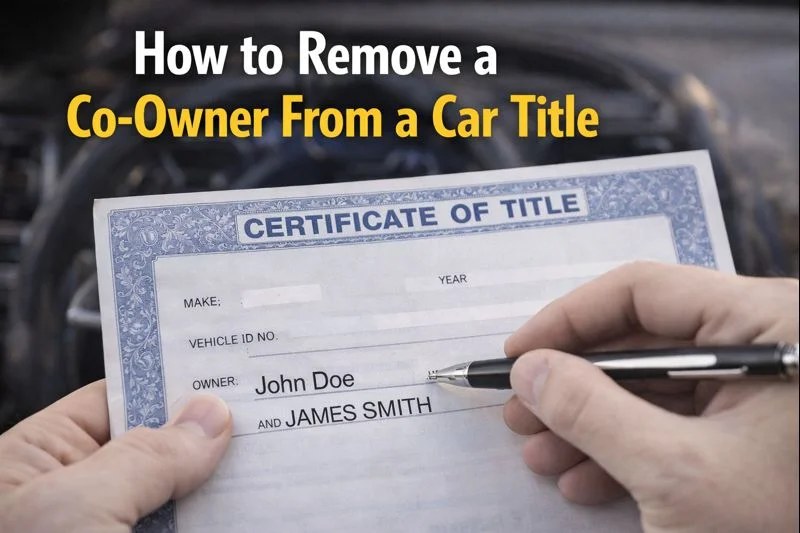
Vehicle ownership can feel straightforward until more than one name appears on the title. Co-ownership is common when cars are purchased by couples, family members, business partners, or when a loan requires an additional signer.
Over time, circumstances change. Relationships evolve, loans get paid off, or one owner simply wants full control of the vehicle. That is when the question comes up: how do you legally remove a co owner from a car title without causing problems later?
This process is not just about scratching off a name. A car title is a legal document, and changing it requires following specific rules set by state motor vehicle authorities.
Skipping steps or using shortcuts can lead to rejected paperwork, ownership disputes, or issues when selling the vehicle in the future.
This article explains the process clearly and professionally, without legal jargon. It covers ownership types, required consent, paperwork, state variations, and common mistakes. By the end, you will know exactly what needs to happen to remove a co owner properly and permanently.
Understanding What A Co Owner Means On A Car Title
A co owner is any additional person listed on a vehicle title besides the primary owner. This listing gives that person legal ownership rights, even if they do not drive the car regularly.
The way names are connected on the title matters. Titles usually list owners using wording such as “and” or “or.” This wording determines how ownership decisions must be made.
Understanding how ownership is structured is the foundation for removing a co owner correctly.
Difference Between “And” And “Or” On A Title
When a title uses “and” between names, both owners must agree to any change. Both signatures are required for selling, transferring, or modifying ownership.
When a title uses “or,” either owner may act independently in many states. This allows one person to sign paperwork without the other present.
This distinction significantly affects how difficult or simple the removal process will be.
Why A Co Owner Must Usually Give Consent
In most cases, removing a co owner requires their permission. Ownership rights cannot be taken away unilaterally.
Even if one person paid for the vehicle or drives it exclusively, the title establishes legal ownership. Motor vehicle agencies rely strictly on title records.
Consent protects both parties and prevents fraudulent transfers.
Situations Where Co Owner Removal Is Common
Common reasons include divorce, separation, inheritance changes, loan payoff, or buying out a partner’s interest.
Parents often remove their name after helping a child purchase a vehicle.
Business partners may remove one name when ownership changes.
Each situation follows similar legal steps, even if the personal reasons differ.
Check If There Is A Loan On The Vehicle
Before any title change, confirm whether the vehicle has an active loan.
If a lender is listed as a lienholder, the title cannot be changed freely. The lender has a legal interest in the vehicle.
Most lenders require the loan to be paid off before allowing a name to be removed from the title.
How Liens Affect Title Changes
A lien means the vehicle is collateral for a loan. Removing a co owner could affect the lender’s security interest.
Once the loan is paid off, the lienholder releases the lien, allowing title changes.
Attempting to modify a title without addressing a lien will usually result in rejection.
Decide How Ownership Will Transfer
Removing a co owner typically involves transferring their ownership interest to the remaining owner.
This transfer can be done as a gift, sale, or part of a legal agreement such as a divorce settlement.
The method used determines whether taxes, fees, or additional documents are required.
Using A Title Transfer To Remove A Co Owner
The most common method is a standard title transfer.
The co owner signs the title over to the remaining owner, similar to selling a car.
The remaining owner then applies for a new title with only one name listed.
How To Complete The Title Assignment Section
The back of the title includes an assignment section where ownership transfer details are entered.
The co owner being removed signs as the seller. The remaining owner signs as the buyer.
Accuracy is critical. Errors, cross-outs, or missing information can delay processing.
When A Bill Of Sale Is Required
Some states require a bill of sale even when transferring ownership between co owners.
This document records the transfer amount, which may be zero if the transfer is a gift.
A bill of sale protects both parties and supports the title application.
Gifting A Vehicle Interest To The Remaining Owner
If the co owner is giving up their share without payment, the transfer may be recorded as a gift.
Gift transfers often reduce or eliminate sales tax, depending on state rules.
Documentation may be required to prove the relationship between parties.
Removing A Co Owner After Divorce
Divorce is a common reason for title changes. Courts often assign vehicle ownership in divorce decrees.
Most motor vehicle departments accept a certified divorce decree as proof of ownership transfer.
Even then, proper title application must still be completed.
Removing A Deceased Co Owner From A Title
If a co owner passes away, the process depends on how the title was worded.
Titles with “or” often allow the surviving owner to remove the deceased person without probate.
Titles with “and” may require probate documents or an affidavit.
State rules vary, so documentation requirements differ.
Required Documents Typically Needed
Most states require the existing title, identification, title application form, and applicable fees.
Additional documents may include a bill of sale, lien release, or court order.
Having all paperwork ready prevents repeat visits.
Visiting The Motor Vehicle Office
Once paperwork is completed, submit it to the local motor vehicle agency.
Some states allow mail-in processing, while others require in-person visits.
Processing times vary, but a new title is usually mailed within a few weeks.
Fees And Taxes To Expect
Title transfer fees are generally modest. Sales tax may apply if the transfer is treated as a sale.
Gift transfers and family transfers may qualify for tax exemptions.
Always verify state-specific fees to avoid surprises.
Common Mistakes That Delay Title Changes
Incomplete signatures are one of the most common problems.
Using white-out or making corrections on the title can invalidate it.
Failing to address a lien almost always causes rejection.
What Happens If The Co Owner Refuses To Sign
If a co owner will not cooperate, removal becomes more complicated.
Legal options may include mediation, court orders, or forced sale depending on circumstances.
Motor vehicle agencies cannot remove a name without proper authorization.
Court Orders And Forced Title Changes
In some cases, a court order can authorize removal of a co owner.
This usually occurs during divorce proceedings or ownership disputes.
The court document must clearly assign ownership to be accepted
Selling The Vehicle Instead Of Removing A Name
If agreement cannot be reached, selling the vehicle and splitting proceeds may be an alternative.
Both owners must typically agree unless legal action dictates otherwise.
This option avoids long-term disputes.
Insurance Updates After Title Changes
After removing a co-owner, insurance policies should be updated immediately.
Ownership changes affect coverage eligibility and claims.
Failing to update insurance can cause complications later.
Registration And Plate Considerations
Some states require registration updates when ownership changes.
License plates may need to be reissued depending on local rules.
Confirm registration status after title processing.
Keeping Records For Future Protection
Retain copies of all documents submitted and received.
This includes the old title, transfer forms, and receipts.
Documentation protects against future ownership disputes.
State Variations You Should Always Check
While processes are similar nationwide, details vary by state.
Forms, fees, and exemptions differ.
Checking official state resources ensures accuracy.
Why Proper Removal Matters Long Term
An incorrectly handled title can cause problems during resale or trade-in.
Old ownership records can create liability issues.
Clear titles protect financial and legal interests.
Professional Help When Needed
Complex situations may benefit from legal or title service assistance.
Professional help reduces errors in high-stakes cases.
This is especially useful for disputes or estate-related transfers.
Final Thoughts
Removing a co owner from a car title is a legal process, not a casual update. It requires cooperation, proper documentation, and attention to detail. Whether the change is due to personal circumstances, financial reasons, or long-term planning, following the correct steps ensures ownership is clean and undisputed.
Taking the time to do it right prevents future headaches, protects your rights, and keeps the vehicle’s legal record accurate. With the right preparation and understanding, removing a co owner from a car title becomes a clear, manageable task rather than a stressful mystery.