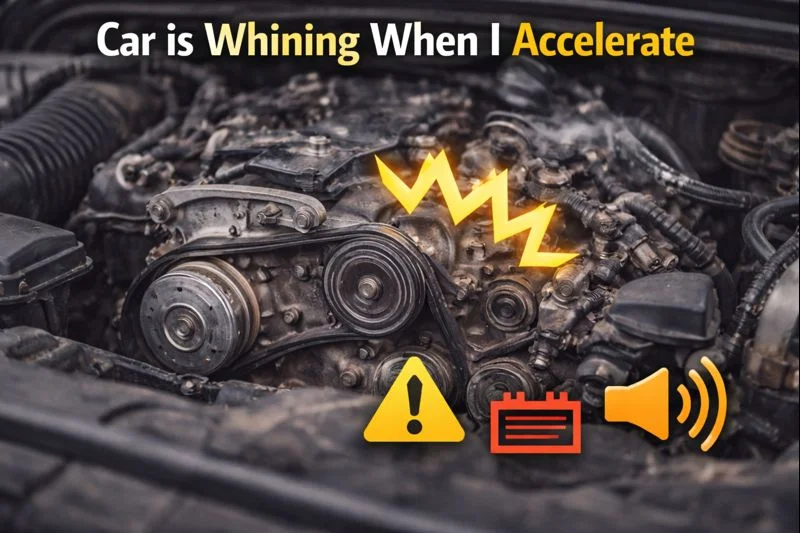
A whining sound during acceleration is one of those noises that immediately catches attention. It is sharper than a rattle, more constant than a clunk, and often rises and falls with engine speed.
Many drivers first notice it while merging onto a highway or pressing the accelerator slightly harder than usual. The car may still feel drivable, which makes the noise easy to dismiss at first. However, whining sounds are rarely harmless.
Acceleration places extra load on the engine, transmission, and drivetrain. When components are under stress, worn bearings, failing pumps, or damaged gears often announce themselves through a high-pitched whine.
In some cases, the sound comes from something simple and affordable to repair. In other situations, it points to deeper mechanical wear that can become expensive if ignored. Because whining noises can originate from several systems, proper identification matters.
Knowing what typically causes this sound, how it behaves under different conditions, and when it becomes urgent helps prevent small issues from turning into major failures.
How Acceleration Triggers Whining Noises
Increased Load On Mechanical Components
When accelerating, the engine produces more power and torque. This extra force travels through belts, pulleys, gears, and bearings. Any component that is worn or struggling under load may begin to whine.
The sound often becomes louder as throttle input increases.
Relationship Between Engine Speed And Noise
A whining noise that changes pitch with engine RPM usually points to rotating components. The faster these parts spin, the higher the pitch of the sound.
This relationship helps narrow down the source.
Why The Noise May Disappear At Steady Speed
At constant cruising speed, load stabilizes. Components are no longer working as hard, so the noise may fade or disappear.
This does not mean the problem is resolved.
Common Causes Of Whining When Accelerating
Transmission Whine
One of the most common causes is transmission-related wear. Bearings, gears, or internal components may produce a high-pitched whine when torque increases.
Automatic, CVT, and manual transmissions can all create whining sounds when internal parts wear or fluid condition declines.
Low Or Degraded Transmission Fluid
Transmission fluid lubricates and cools internal components. When fluid is low, dirty, or degraded, friction increases.
This friction often produces a noticeable whining sound during acceleration.
Power Steering Pump Issues
A failing power steering pump can whine when engine speed rises. The sound may be louder during acceleration or when turning the steering wheel.
Low power steering fluid is a common trigger.
Differential Or Final Drive Wear
The differential transfers power to the wheels. Worn gears or bearings inside the differential often create a whine that increases with acceleration.
Rear-wheel-drive and all-wheel-drive vehicles experience this more frequently.
Wheel Bearings Under Load
While wheel bearing noise is often associated with speed, worn bearings can also whine under acceleration as load shifts.
The sound may change when turning.
Engine And Accessory Related Sources
Serpentine Belt And Pulley Problems
Worn belts or failing pulleys can produce a whining or squealing sound when engine speed increases.
This noise may be louder during cold starts or under heavy electrical load.
Alternator Whine
A failing alternator can create a high-pitched whine that changes with RPM. Electrical load increases during acceleration, making the sound more noticeable.
Dim lights or charging issues often accompany this noise.
Air Intake Or Vacuum Leaks
Air leaks in the intake system can produce a whistling or whining sound under throttle.
These leaks often affect engine performance as well.
Turbocharger Noise
In turbocharged vehicles, a whining sound during acceleration may come from the turbo itself. Some whine is normal, but excessive or new noise may indicate bearing wear.
Turbo noise usually increases sharply with throttle input.
Drivetrain And Axle Related Issues
CV Joint And Axle Wear
Front-wheel-drive and all-wheel-drive vehicles use CV joints to deliver power. Worn joints can whine or hum under acceleration.
The sound may worsen during turns.
Driveshaft And U-Joint Problems
Rear-wheel-drive vehicles rely on driveshafts and U-joints. Wear in these components can cause whining or vibration during acceleration.
Noise often increases with speed.
Transmission Mount Wear
Worn mounts allow excessive movement during acceleration. This movement can amplify noise from the drivetrain.
Mount failure often causes clunks as well.
How The Sound Changes Based On Driving Conditions
Whine Only During Acceleration
Noise limited to acceleration often points to load-related issues such as gears, bearings, or pumps.
This pattern is significant.
Whine At Acceleration And Deceleration
If the sound appears both when accelerating and slowing down, differential or transmission gear wear is likely.
Gear mesh problems create noise under changing load.
Whine That Increases With Speed
Noise that grows steadily with speed often involves wheel bearings, differentials, or drivetrain components.
Speed-dependent sounds require careful inspection.
Warning Signs That Indicate Serious Trouble
Burning Smell
A burning odor combined with whining suggests overheating fluid or internal friction.
Immediate inspection is recommended.
Delayed Or Harsh Shifting
If whining occurs alongside shifting problems, transmission wear is likely.
Ignoring this combination risks complete failure.
Dashboard Warning Lights
Transmission, power steering, or charging system warnings should never be ignored.
Lights often confirm internal stress.
Sudden Change In Noise Volume
A sudden increase in noise indicates rapid deterioration.
This often precedes component failure.
How Serious Is A Whining Noise When Accelerating
Minor Issues
Low fluid levels, worn belts, or loose components may produce whining sounds that are relatively inexpensive to fix.
Early attention prevents escalation.
Moderate Mechanical Wear
Differential bearings, CV joints, or power steering pumps fall into mid-range repair categories.
Delaying repair increases cost.
Severe Internal Damage
Transmission or differential gear damage can lead to complete failure.
These repairs are costly and time-sensitive.
How To Narrow Down The Source At Home
Listen To Location
Noise from the front may indicate engine accessories or transmission. Noise from the rear often points to differential issues.
Location provides clues.
Observe When The Noise Occurs
Note whether the sound changes with speed, RPM, or steering input.
Patterns help diagnosis.
Check Fluid Levels
Low transmission, power steering, or differential fluid often causes whining.
Fluid checks are simple and valuable.
Professional Diagnosis And What To Expect
Road Test Evaluation
Technicians often drive the vehicle to replicate the noise under controlled conditions.
This confirms patterns and load behavior.
Lift Inspection
Inspecting under the vehicle reveals leaks, worn mounts, and drivetrain issues.
Visual inspection is critical.
Fluid Analysis
Fluid condition provides insight into internal wear.
Burnt or metallic fluid signals damage.
Repair Costs And Typical Price Ranges
Low-Cost Repairs
Fluid service, belt replacement, or minor adjustments may cost a few hundred dollars.
These are common early fixes.
Mid-Range Repairs
Power steering pumps, wheel bearings, or CV axles cost more due to labor.
Prices vary by vehicle design.
High-Cost Repairs
Transmission or differential rebuilds can cost thousands.
Early repair reduces this risk.
Can You Keep Driving With A Whining Noise
Short-Term Driving
Some vehicles can be driven briefly with minor whining, but risk increases daily.
Noise rarely resolves on its own.
Long-Term Consequences
Continued driving accelerates wear and spreads damage.
What starts small often becomes major.
Safety Concerns
Loss of power, steering assistance, or drivetrain failure can create dangerous situations.
Reliability is a safety issue.
Preventing Whining Noises In The Future
Regular Fluid Maintenance
Fresh fluids protect bearings and gears.
Service intervals matter.
Inspecting Belts And Pulleys
Early replacement prevents accessory noise.
Worn parts rarely improve.
Addressing Small Leaks Quickly
Fluid leaks lead to lubrication failure.
Prompt repair saves money.
Avoiding Aggressive Driving
Hard acceleration increases stress on components.
Smooth driving extends lifespan.
Common Misconceptions About Whining Sounds
Many believe whining is normal as vehicles age. While wear increases over time, persistent whining is not normal.
Another myth is that turning up the radio solves the problem. Noise is a warning signal.
Ignoring sound never prevents damage.
Final Thoughts
When a car is whining during acceleration, it is signaling stress somewhere in the drivetrain, engine accessories, or transmission system. Acceleration exposes weaknesses because components are under maximum load. Some causes are simple, such as low fluid or worn belts, while others point to serious internal wear that can lead to failure if ignored.
Paying attention to when the sound occurs, how it changes, and where it comes from helps identify the problem early. Prompt inspection and repair not only restore quiet operation but also protect critical components from further damage. Whining noises are never just background sound. They are the vehicle’s way of asking for attention before a small issue becomes an expensive one.