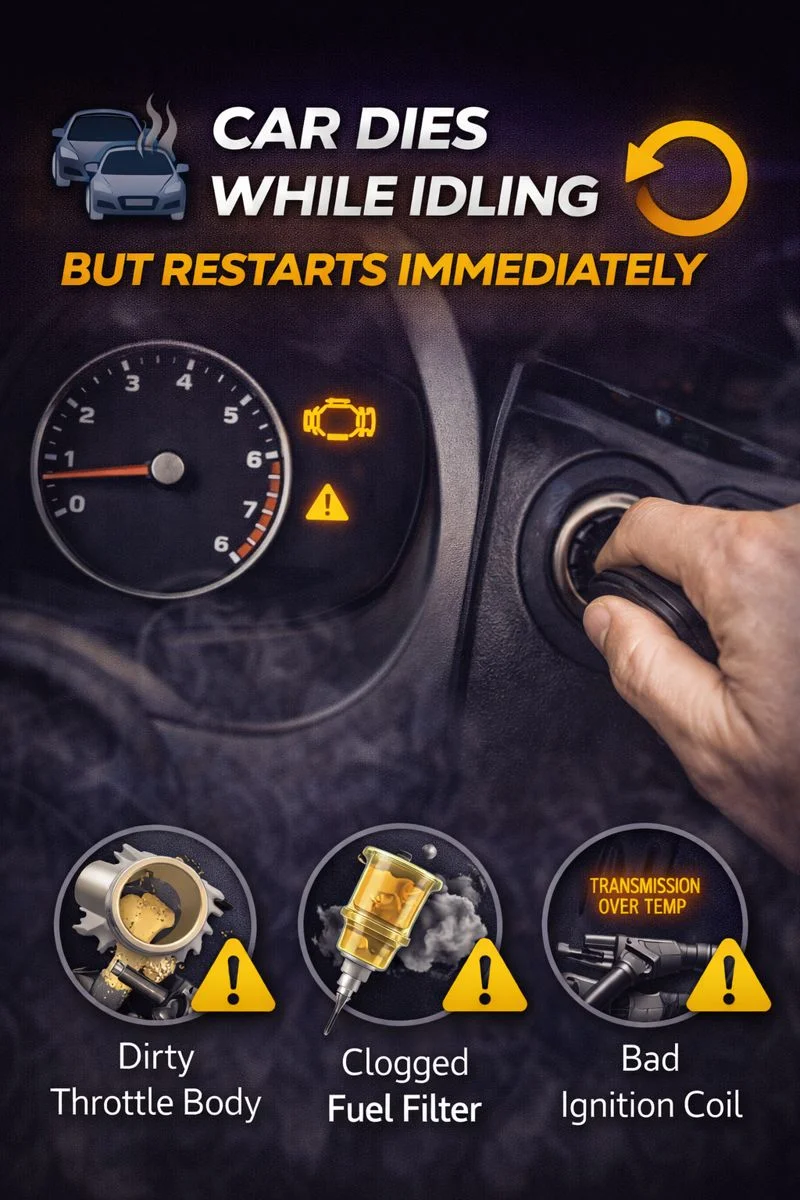
When a car shuts off at idle and then starts right back up, it creates a strange mix of relief and concern. On one hand, the engine is not completely dead. On the other, something clearly is not right.
This type of problem often shows up at traffic lights, in parking lots, or while waiting with the engine running. The car may idle roughly for a moment, stall suddenly, and then restart as if nothing happened. Because the issue does not leave you stranded, it is easy to ignore or postpone checking it.
In reality, this behavior is one of the clearest signs that the engine is struggling to maintain stable operation at low speed. Idling places unique demands on airflow, fuel delivery, and engine control systems.
When any of those systems fall slightly out of balance, the engine may not be able to sustain itself without throttle input. This article explains why cars die at idle but restart immediately, how the problem usually develops, and what actually fixes it when handled correctly.
Why Engines Are Most Vulnerable At Idle
Idle is the most delicate operating condition for an engine. At higher speeds, momentum helps keep the engine running smoothly even if something is slightly off. At idle, there is very little margin for error.
The engine relies on precise airflow control, accurate sensor data, and stable fuel delivery to maintain a steady idle speed. Any interruption or incorrect signal can cause the engine speed to drop below its minimum threshold. When that happens, the engine stalls. Since most systems recover instantly, restarting the engine is usually easy, which is why the problem feels intermittent and confusing.
This sensitivity explains why many idle-related problems do not appear while driving. The engine performs well under load, yet fails when sitting still.
The Most Common Patterns Owners Notice
Many drivers report that the engine stalls only after warming up. Cold starts may be smooth, but once the engine reaches operating temperature, idle becomes unstable.
Others notice stalling when shifting into gear, especially from Park to Drive or Reverse. The extra load from the transmission drops idle speed just enough to cause a stall.
Some experience stalling only when accessories are running. Air conditioning, headlights, or power steering increase engine load at idle. If the engine cannot compensate, it may shut off.
The key pattern is consistency at idle combined with normal operation during driving.
Airflow Problems That Disrupt Idle Stability
One of the most common causes of idle stalling is restricted or uncontrolled airflow.
The throttle body plays a major role in idle control. Over time, carbon builds up around the throttle plate. At idle, the plate is nearly closed, so even small deposits can reduce airflow enough to cause stalling. When the engine stalls and is restarted, the throttle briefly opens during starting, allowing the engine to run again.
Idle air control systems are designed to regulate airflow at idle. Whether through a dedicated valve or electronic throttle control, these systems adjust airflow constantly. If they stick, react slowly, or fail, idle speed can drop suddenly.
Vacuum leaks also fall into this category. Cracked hoses, loose fittings, or leaking gaskets allow unmetered air into the engine. This disrupts the air-fuel balance, especially at idle, where airflow is already minimal.
Fuel Delivery Issues That Appear Only At Idle
Fuel problems do not always show up as hard starts or misfires. At idle, fuel delivery must be extremely precise.
Dirty fuel injectors can cause uneven fuel flow. At higher speeds, the engine compensates, but at idle, the imbalance can cause stalling.
Weak fuel pressure from a failing pump or regulator may still be enough for cruising but insufficient to maintain idle under load. This often results in stalling when stopping or idling with accessories on.
Contaminated fuel or water in the fuel system can also cause intermittent stalling, especially at low speed.
Sensors That Quietly Cause Stalling
Modern engines rely on sensors to adjust fuel and airflow in real time. When these sensors send incorrect data, idle control suffers.
The mass airflow sensor measures incoming air. If it becomes dirty or fails, the engine computer miscalculates fuel needs. At idle, this miscalculation can be enough to stall the engine.
The throttle position sensor tells the computer how open the throttle is. Incorrect readings may cause the engine to mismanage idle airflow.
The engine coolant temperature sensor informs the system whether the engine is cold or warm. If it reports incorrect temperature, the engine may not receive the correct fuel mixture at idle.
Crankshaft and camshaft position sensors can also cause sudden stalling. If the signal drops momentarily, the engine shuts off. Restarting is often immediate once the signal returns.
Electrical And Charging System Influences
Electrical stability matters more at idle than many people realize.
A weak battery or failing alternator may still support driving but struggle at idle, where voltage output is lower. When voltage drops, engine control modules and sensors may not function correctly, leading to stalling.
Poor ground connections create similar issues. Loose or corroded grounds interrupt electrical flow, especially at low engine speed.
These problems often come and go, making diagnosis more difficult.
Transmission And Load-Related Causes
When a car stalls as soon as it is shifted into gear, transmission-related factors should be considered.
A failing torque converter or torque converter clutch may not release properly at idle, dragging the engine speed down.
Idle speed calibration also plays a role. If idle speed is set too low, engaging the transmission adds just enough load to cause stalling.
Exhaust And Emissions Issues That Affect Idle
Restricted exhaust flow can cause stalling, especially at idle.
A partially clogged catalytic converter may allow enough flow for driving but restrict exhaust at low speed.
Exhaust gas recirculation systems that remain open at idle introduce exhaust gases when they should not. This disrupts combustion and can stall the engine.
Why Restarting Works So Easily
Restarting temporarily resets several engine control processes. Sensors reinitialize, airflow changes, and fuel delivery briefly enriches. This allows the engine to start and idle again, masking the underlying problem.
As the engine returns to idle conditions, the issue reappears. This cycle explains why the problem feels random but follows a pattern.
How The Problem Progresses Over Time
Idle stalling rarely fixes itself. What starts as an occasional stall often becomes more frequent.
Over time, the engine may stall more aggressively, struggle to restart, or begin stalling during deceleration.
Ignoring the problem allows carbon buildup, sensor degradation, or fuel system wear to worsen, increasing repair costs.
Practical Steps To Narrow Down The Cause
Observation is the first diagnostic tool. Noting when the stalling happens provides valuable clues.
Does it happen only when warm? Only with the air conditioning on? Only when shifting into gear? Each detail points toward specific systems.
Listening for unusual sounds, watching idle speed fluctuations, and checking for warning lights also helps narrow the cause.
Scanning for stored diagnostic codes is essential, even if the check engine light is off. Many idle-related faults store history codes without triggering a warning light.
Fixes That Commonly Resolve Idle Stalling
Cleaning the throttle body is one of the most effective first steps. In many cases, this alone restores stable idle.
Addressing vacuum leaks by replacing hoses or gaskets often eliminates stalling.
Cleaning or replacing airflow and temperature sensors improves idle accuracy.
Fuel system cleaning or injector service may be needed when uneven fuel delivery is suspected.
Electrical system inspection ensures voltage stability at idle.
Why Random Parts Replacement Fails
Replacing parts without diagnosis often leads to frustration and wasted money. Idle stalling is rarely caused by a single obvious failure.
Multiple systems interact at idle. Fixing one symptom without addressing the root cause allows the problem to return.
A structured approach based on symptoms and data produces better results.
When Stalling Becomes A Safety Concern
Stalling in traffic, at intersections, or during parking maneuvers increases risk. Loss of power steering or brake assist, even briefly, can be dangerous.
If stalling becomes frequent or unpredictable, driving should be limited until the issue is resolved.
Preventing Idle Stalling In The Future
Regular maintenance reduces the likelihood of idle problems. Throttle body cleaning, timely sensor service, and fuel system care keep idle systems working correctly.
Electrical connections should be inspected periodically, especially on older vehicles.
Addressing small drivability changes early prevents more serious issues later.
Final Thoughts
A car that dies while idling but restarts immediately is not behaving normally, even if it seems manageable at first. This pattern almost always points to airflow, fuel, sensor, or electrical imbalance that shows up under the most sensitive operating condition.
The encouraging part is that these problems are well understood and often fixable without major repairs when addressed early. Paying attention to patterns, avoiding guesswork, and focusing on idle-specific systems leads to accurate diagnosis and lasting repair. Restoring a stable idle does more than prevent stalling — it returns confidence and reliability to everyday driving, exactly where it matters most.