Air conditioning systems are designed to keep cabin temperatures stable whether a vehicle is parked, idling at a red light, or cruising down the highway. When cool air flows strongly at highway speeds but turns warm during idle, it signals that something in the cooling process depends on vehicle movement. That pattern narrows the problem quickly.
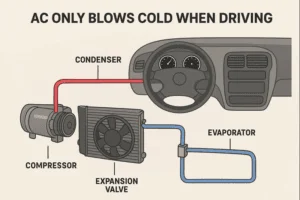
An automotive AC system relies on refrigerant pressure, airflow across the condenser, compressor operation, and proper electrical control. At highway speeds, natural airflow passes through the front grille, assisting cooling. When the vehicle stops, electric cooling fans take over. If those fans fail or refrigerant pressure drops too low, cooling performance suffers at idle.
This issue is common across many makes and models. It rarely indicates total system failure, but it does require timely attention. Ignoring it can lead to compressor strain or complete loss of cooling performance. Identifying the root cause ensures consistent cabin comfort in both traffic and open-road conditions.
How The AC System Relies On Airflow
Role Of The Condenser In Cooling
The condenser sits at the front of the vehicle, typically just behind the grille and in front of the radiator. Its purpose is to release heat from refrigerant gas after it leaves the compressor. As air passes through the condenser fins, heat transfers from the refrigerant to the outside air.
When driving at higher speeds, airflow naturally increases. Even if the cooling fan is weak or inactive, highway movement forces enough air through the condenser to maintain proper cooling.
At idle, there is no natural airflow. The system depends entirely on electric fans to move air across the condenser surface. If airflow decreases, refrigerant cannot cool effectively. As a result, vent air temperature rises.
This explains why cooling improves once the vehicle begins moving again.
Electric Cooling Fan Importance
Cooling fans activate automatically when engine temperature rises or when AC pressure increases. They pull air through the condenser and radiator.
A malfunctioning fan motor, faulty relay, or blown fuse prevents airflow at idle. The AC may blow cold briefly, then gradually turn warm as pressure builds.
Testing fan operation while the AC is running at idle is one of the simplest diagnostic steps. If fans do not engage, electrical troubleshooting becomes necessary.
Reliable fan operation ensures consistent cooling regardless of vehicle speed.
Refrigerant And Pressure Related Causes
Low Refrigerant Charge
Refrigerant levels must remain within a specific pressure range for proper cooling. Low refrigerant may still produce cold air while driving due to enhanced airflow but fail at idle when condenser efficiency drops.
Insufficient refrigerant reduces system pressure balance. This causes inconsistent evaporator performance and fluctuating vent temperatures.
Leaks are the most common cause of low refrigerant. O-rings, hose connections, and compressor seals may allow gradual loss.
Pressure testing and proper recharge restore cooling stability.
Ignoring low refrigerant risks compressor damage due to inadequate lubrication.
Overcharged System Complications
Too much refrigerant can also create idle cooling problems. Overcharging raises system pressure, forcing the compressor to work harder.
At idle, pressure buildup may reduce cooling output and cause warm air discharge.
Professional servicing ensures proper refrigerant levels.
Balanced pressure is essential for efficient performance.
Compressor And Control Issues
Weak Or Failing Compressor
The compressor circulates refrigerant through the system. If internal wear reduces pumping efficiency, cooling may weaken at low engine speeds.
Higher RPM during driving may temporarily compensate, masking the issue.
A failing compressor often produces inconsistent cooling patterns before complete failure.
Listening for unusual noises or observing clutch engagement behavior helps identify compressor problems.
Timely replacement prevents further system damage.
Faulty Compressor Clutch
The compressor clutch engages and disengages to regulate cooling. If the clutch slips or fails intermittently, cooling performance becomes unpredictable.
At idle, insufficient engagement may reduce refrigerant flow.
Testing clutch voltage supply and gap clearance identifies potential faults.
Reliable clutch operation ensures steady refrigerant circulation.
Airflow Obstructions And Mechanical Concerns
Blocked Or Dirty Condenser Fins
Road debris, dirt, or bent fins can restrict airflow through the condenser. Even with functioning fans, restricted airflow limits heat dissipation.
Inspection of condenser surface for debris accumulation is important.
Cleaning the condenser carefully restores airflow efficiency.
Maintaining clear airflow pathways improves cooling consistency.
Engine Overheating Interaction
High engine temperature can influence AC performance. If the engine runs hotter than normal, cooling fans prioritize radiator cooling.
In extreme cases, the AC system may temporarily reduce performance to protect engine components.
Addressing engine cooling system issues supports AC stability.
Balanced engine temperature maintains optimal refrigerant performance.
Electrical And Sensor Related Factors
Faulty Pressure Switches
AC pressure switches monitor refrigerant levels and protect the system from damage. If a switch sends incorrect signals, it may disable compressor operation at idle.
Testing pressure sensor output ensures accurate system communication.
Replacing faulty switches restores proper compressor engagement.
Climate Control Module Glitches
Modern vehicles use electronic climate control modules to regulate cooling. Software faults or sensor errors can disrupt operation.
Diagnostic scanning identifies stored fault codes.
Reprogramming or replacing faulty modules corrects inconsistent behavior.
Practical Diagnostic Direction
Observe Cooling Fan Operation
Start the vehicle and turn on the AC while parked. Confirm that cooling fans activate promptly.
If fans remain inactive, inspect fuses, relays, and fan motors.
Airflow verification often resolves the issue quickly.
Check Refrigerant Pressure
Using professional gauges, measure high and low side pressures at idle and during higher RPM.
Pressure imbalance reveals whether refrigerant charge is appropriate.
Accurate measurement prevents unnecessary part replacement.
Inspect Compressor Engagement
Watch the compressor clutch while AC is running. Ensure steady engagement without rapid cycling.
Inconsistent operation suggests electrical or mechanical failure.
Clear visual inspection simplifies diagnosis.
Conclusion
An air conditioning system that cools properly while driving but warms at idle almost always relates to airflow or refrigerant pressure imbalance. Electric cooling fan failure remains the most common cause, followed by low refrigerant levels or compressor weakness.
Highway airflow can temporarily mask underlying issues. Once vehicle speed drops, inadequate condenser cooling reduces system efficiency.
Thorough inspection of fan operation, refrigerant charge, and compressor function identifies the root cause. Prompt repair restores consistent cooling in both traffic and open-road conditions, ensuring reliable cabin comfort in any environment.