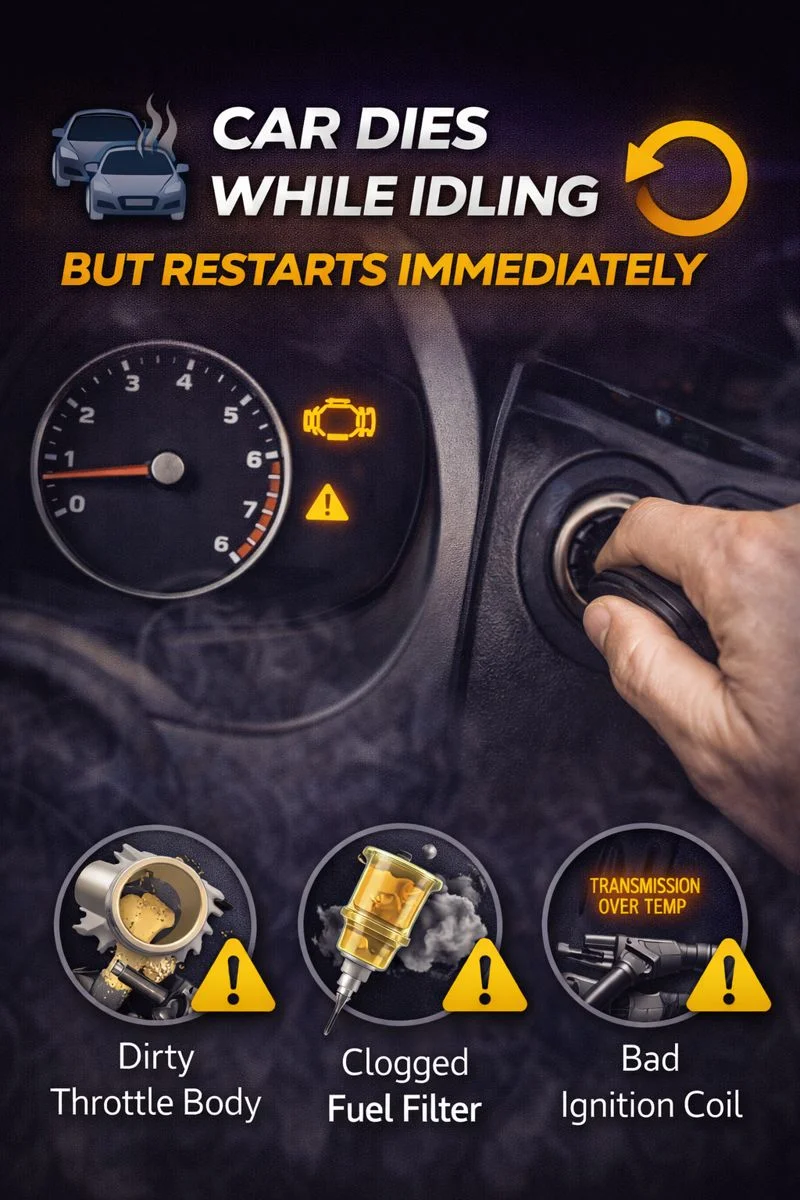
An engine shutting off while idling can be frustrating, confusing, and sometimes dangerous, especially when the vehicle starts again immediately as if nothing happened. Many drivers notice the engine suddenly dying at traffic lights, in parking lots, during stop-and-go traffic, or while waiting with the air conditioner running. In some situations, the dashboard lights remain active, the starter cranks normally, and the engine fires back up within seconds without much struggle. Because the car restarts so easily, many people assume the issue is minor and continue driving without investigating the cause.
Idle speed operation places unique stress on the engine because RPM stays very low while the vehicle still depends on stable airflow, proper fuel delivery, strong ignition performance, and accurate sensor readings. Even a small interruption in one of these systems can cause the engine to shut off temporarily. Weak fuel pumps, dirty throttle bodies, vacuum leaks, failing crankshaft sensors, low charging voltage, and idle control problems are among the most common reasons vehicles stall while idling but restart immediately afterward.
Intermittent stalling rarely fixes itself permanently. In many cases, the problem slowly worsens until the engine begins stalling more frequently or eventually refuses to restart altogether. Identifying the root cause early helps avoid unexpected breakdowns, unsafe traffic situations, and larger repair costs later.
Why Engines Stall More Easily At Idle
Idle conditions create one of the most sensitive operating situations for any engine because the engine must remain stable while producing very little power.
Low RPM Leaves Little Room For Error
When an engine idles, RPM usually remains between 600 and 900 depending on vehicle design and operating temperature. At such low speeds, the engine has minimal rotational momentum compared to highway cruising or acceleration.
Small airflow disruptions, weak fuel pressure, or electrical irregularities that might go unnoticed at higher RPM can immediately affect idle stability. The engine control module constantly adjusts fuel mixture, ignition timing, and airflow to maintain smooth idle operation.
At idle, several systems continue operating simultaneously:
- Alternator charging
- Cooling fans
- Power steering load
- Air conditioning compressor
- Fuel injection
- Ignition timing
Any weakness in these systems may lower engine speed enough to stall the engine completely.
During acceleration, increased RPM and fuel flow often help compensate for small problems temporarily. At idle, however, the engine becomes much more sensitive to interruptions.
This explains why some vehicles stall only while stopped but drive normally once moving again.
| Engine Condition | Idle Sensitivity |
|---|---|
| Low RPM | High Stall Risk |
| Electrical Load Increase | RPM Drop |
| Poor Airflow Control | Rough Idle |
| Weak Fuel Delivery | Sudden Shutdown |
Some Failures Happen Too Quickly For Warning Lights
Many drivers expect the check engine light to appear immediately whenever the engine stalls. However, intermittent problems often occur too quickly or inconsistently for the engine computer to store a confirmed fault code.
Sensors and electronic systems operate within programmed thresholds. If a signal disappears only briefly before returning to normal, the engine control module may not illuminate the warning light immediately.
Common examples include:
- Crankshaft sensor interruptions
- Voltage drops
- Temporary fuel pressure loss
- Intermittent wiring faults
Pending codes may still exist internally even when no warning light appears on the dashboard.
Because intermittent stalling can happen without obvious fault codes, diagnosis sometimes requires observing patterns carefully rather than relying only on warning lights.
Immediate Restart Does Not Mean The Problem Is Harmless
A car restarting instantly after stalling often gives the impression that the issue is minor. However, many components fail intermittently during early stages before eventually failing completely.
Heat-sensitive sensors, weak fuel pumps, loose electrical connections, and charging system problems frequently behave this way.
Initially, the engine may restart easily because:
- The component cools slightly
- Voltage stabilizes temporarily
- Fuel pressure returns briefly
- The sensor reconnects momentarily
As wear progresses, restart times often become longer and stalling frequency increases.
Ignoring early stalling symptoms may eventually lead to:
- Highway shutdowns
- Complete no-start conditions
- Increased repair costs
- Dangerous traffic situations
Airflow And Idle Control Problems
Modern engines rely heavily on controlled airflow during idle conditions. Even small airflow irregularities can cause stalling.
Dirty Throttle Body Restricts Idle Airflow
The throttle body controls air entering the engine. Over time, carbon deposits build around the throttle plate and idle air passages because of oil vapors and combustion residue.
At higher RPM, the engine can often compensate for mild restrictions by opening the throttle further. At idle, however, airflow becomes extremely limited and sensitive.
Common symptoms include:
- Rough idle
- Stalling at stops
- RPM fluctuation
- Hard starting
- Delayed throttle response
Electronic throttle systems attempt to adjust automatically, but excessive buildup may prevent proper idle airflow completely.
Cleaning the throttle body often restores stable idle operation, especially on higher-mileage vehicles.
Neglected throttle body deposits commonly worsen slowly over time until intermittent stalling develops.
| Airflow Problem | Possible Symptom |
|---|---|
| Dirty Throttle Body | Rough Idle |
| Carbon Buildup | Engine Stalling |
| Sticking Throttle Plate | RPM Fluctuation |
| Restricted Idle Passage | Sudden Shutdown |
Idle Air Control Valve Failure
Older vehicles commonly use an idle air control valve to regulate idle speed directly. This valve adjusts airflow around the throttle plate based on engine load and operating conditions.
If the valve sticks, becomes dirty, or fails electronically, the engine may struggle to maintain proper idle RPM.
Additional loads such as:
- Air conditioning
- Steering input
- Electrical demand
can overwhelm the idle system and cause stalling.
Some idle air control valves fail intermittently, causing unpredictable stalling behavior while still allowing immediate restart afterward.
Cleaning or replacing the valve often solves these problems if diagnosed early.
Vacuum Leaks Create Lean Idle Conditions
Vacuum leaks allow unmetered air into the engine after the airflow sensor measures intake volume.
At idle, the engine relies on extremely precise fuel mixtures. Extra air entering through cracked hoses or leaking gaskets may create unstable combustion and stalling.
Common vacuum leak sources include:
- Intake manifold gaskets
- PCV hoses
- Brake booster leaks
- Vacuum lines
- Throttle body gaskets
Symptoms often include:
- Hissing sounds
- Rough idle
- High idle RPM
- Hesitation
- Intermittent stalling
Vacuum leaks sometimes worsen as components heat up and expand.
Fuel And Ignition Problems That Cause Idle Stalling
Fuel delivery and ignition systems play critical roles in keeping the engine running smoothly at low RPM.
Weak Fuel Pump Or Fuel Pressure Loss
Fuel pumps maintain stable pressure throughout the fuel system. Aging pumps sometimes struggle to maintain pressure consistently during idle operation.
Heat buildup inside the fuel pump may worsen performance temporarily, especially after extended driving.
Symptoms may include:
- Sudden stalling
- Long crank times
- Hesitation
- Weak acceleration
- Intermittent restart issues
At higher RPM, fuel demand changes and pressure may stabilize briefly. During idle, however, even small pressure drops can interrupt combustion and stall the engine.
Fuel filter restrictions may also contribute to unstable pressure.
Because intermittent fuel problems can recover quickly, the vehicle often restarts immediately after stalling.
| Fuel System Issue | Common Result |
|---|---|
| Weak Fuel Pump | Sudden Stall |
| Dirty Fuel Injector | Rough Idle |
| Clogged Fuel Filter | Hesitation |
| Fuel Pressure Drop | Engine Shutdown |
Crankshaft Position Sensor Failure
The crankshaft position sensor tracks engine rotation and timing. The engine computer depends heavily on this signal to control ignition and fuel injection accurately.
If the signal disappears even briefly, the engine may shut off instantly because the computer loses synchronization.
Early crankshaft sensor failures often appear intermittently. Heat frequently affects sensor operation because internal resistance changes with temperature.
Common symptoms include:
- Random stalling
- Immediate restart
- Tachometer fluctuation
- No warning light initially
- Stalling after warming up
Eventually, the sensor may fail completely and prevent restarting altogether.
Ignition Coil And Spark Problems
Weak ignition coils or worn spark plugs may also create unstable idle conditions.
At idle, combustion becomes more sensitive because the engine operates at lower energy levels. Weak spark output may cause misfires severe enough to stall the engine temporarily.
Additional symptoms may include:
- Rough idle
- Hesitation
- Fuel smell
- Reduced fuel economy
- Hard acceleration
Moisture, heat, and electrical wear gradually weaken ignition components over time.
Electrical And Charging System Failures
Modern engines depend heavily on stable electrical power during idle operation.
Weak Alternator Output At Idle
Alternators produce less charging current at idle than during higher RPM operation.
A failing alternator may supply enough voltage while driving but struggle to maintain proper electrical output while stopped.
Voltage drops may affect:
- Fuel injectors
- Ignition coils
- Engine control module
- Sensors
- Idle control systems
Symptoms may include:
- Flickering lights
- Radio resets
- Stalling with AC on
- Battery warning light
- Dim headlights
Once RPM increases again after restarting, charging output may temporarily improve.
Loose Ground Connections
Ground wires complete electrical circuits throughout the vehicle. Loose or corroded grounds may interrupt voltage flow unpredictably.
Intermittent electrical interruption may shut off the engine suddenly while still allowing immediate restart once contact returns.
Ground problems often create difficult-to-diagnose symptoms including:
- Random stalling
- Dashboard glitches
- Electrical flickering
- Sensor communication faults
Battery terminals and engine grounds should always be inspected carefully during diagnosis.
| Electrical Failure | Common Symptom |
|---|---|
| Weak Alternator | Voltage Drop |
| Bad Ground Wire | Random Stall |
| Battery Connection Issue | Electrical Flicker |
| Sensor Power Loss | Sudden Shutdown |
Failing Engine Control Relays
Relays control power distribution to critical systems such as fuel pumps and engine computers.
Heat-sensitive relays may lose internal contact temporarily during idle conditions, especially in hot weather or after long drives.
The engine may shut off instantly but restart moments later once the relay reconnects internally.
Relay failures are often intermittent during early stages and may not trigger warning lights immediately.
Diagnosing And Preventing Idle Stalling
Careful diagnosis becomes important because intermittent stalling often disappears temporarily before inspection begins.
Observe The Exact Conditions
Drivers should notice:
- Engine temperature
- Weather conditions
- Fuel level
- Air conditioner usage
- Electrical load
Patterns often reveal whether the issue involves heat-related sensors, voltage instability, or airflow control.
For example:
- Hot restarts may suggest crankshaft sensor problems
- AC-related stalls may indicate idle control weakness
- Low-fuel stalling may point toward fuel pump wear
Scan For Pending Codes
Even without dashboard warnings, pending trouble codes may exist inside the engine computer.
Professional scan tools can detect:
- Misfire history
- Fuel trim irregularities
- Sensor interruptions
- Voltage problems
Hidden codes often provide valuable clues during intermittent failure diagnosis.
Maintain Idle-Related Components Regularly
Routine maintenance greatly reduces idle stalling risks.
Helpful services include:
- Throttle body cleaning
- Air filter replacement
- Battery inspection
- Fuel system cleaning
- Spark plug replacement
Clean airflow systems and stable voltage help maintain smoother idle operation long term.
Conclusion
A car that dies while idling but restarts immediately usually suffers from intermittent airflow, fuel delivery, sensor, ignition, or electrical problems that become most noticeable at low RPM. Idle operation places unique stress on the engine because there is very little room for small disruptions before the engine stalls completely.
Dirty throttle bodies, weak fuel pumps, vacuum leaks, crankshaft sensor failures, low charging voltage, ignition issues, and electrical connection problems remain some of the most common causes. Although the engine may restart easily afterward, intermittent stalling should never be ignored because many failing components worsen gradually over time.
Careful diagnosis, regular maintenance, and early attention to warning signs help prevent larger failures and improve overall engine reliability. Observing stall patterns closely often provides the best clues for identifying the root cause before the problem becomes more severe.