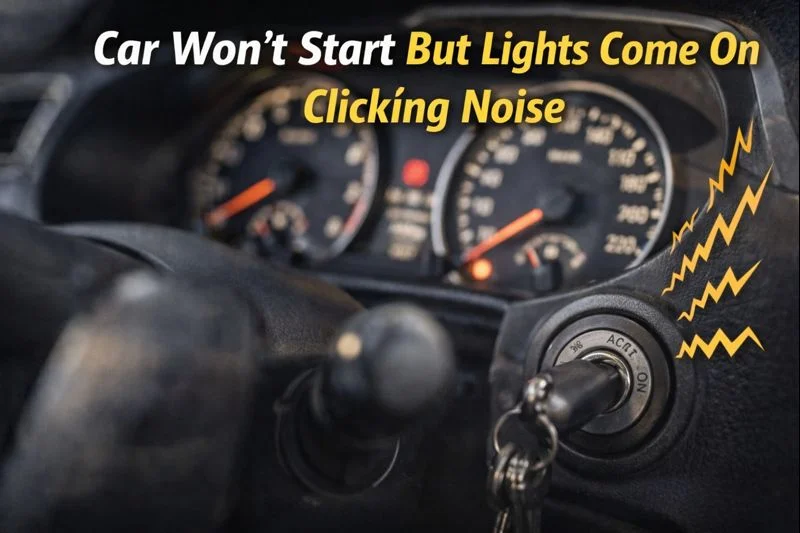
When you get into the car, everything seems normal — dashboard lights glow, radio powers up, headlights work — but when you turn the key (or press Start) you hear a rapid or single clicking sound and the engine won’t crank.
It’s a tiny moment that suddenly feels huge: you’re stranded, you have an appointment, and nothing obvious tells you what failed. That exact scenario is one of the most common and most fixable problems drivers face.
In this guide I’ll take you from the first click to a confident diagnosis, showing which parts truly cause clicking, how to test them without frying anything, what repairs cost, and when to call a professional.
I’ll blend practical garage logic (what I’d try first if this car rolled into my bay) with reliable facts from trusted sources so you know what to do right now — and how to avoid the same problem next month.
Short note on sources
This guide uses practical diagnostic logic like Firestone Complete Auto Care combined with authoritative sources to ensure accuracy. The testing procedures explaining alternator and battery behavior (including voltage thresholds and load testing) from practical repair and tech sites.
Additional shop-facing resources and tool guides from battery and parts retailers that document cable, relay, and starter failure modes.
What the clicking actually means — one sentence worth remembering
When the dash lights work but the starter only clicks, the electrical system can power small loads but cannot deliver the high current the starter motor needs; that points to either insufficient battery current, poor connections, a failed starter/solenoid, or security/relay interruptions.
That sentence frames everything that follows: the difference between “lights on” and “engine cranks” is amperage and a path for that high current.
Quick diagnosis map — do these three checks first
Before you reach for tools, do three quick checks in this order. They are fast, safe, and will rule out the most common causes.
- Try to start again with all accessories off (radio, lights). Did the sound change?
- Turn on the headlights — brace them and try to start. If the headlights dim severely when you press Start, the battery is weak or connections are poor. If they don’t change, the starter or control circuit may not be seeing power.
- Look for obvious signs: a single heavy click? repeated rapid clicks? No click at all? The pattern points you toward different faults (single click → starter solenoid/stuck starter; rapid clicking → battery/connection). Firestone and AAA describe this pattern clearly.
If you want the long version of each interpretation, read on — I’ll show tests and what they mean.
The usual suspects
Below are the parts that cause “lights on, clicking” most often. I’ll explain why each one makes the symptom, how to test it, and what typical fixes cost.
1) Weak or dead battery — the top cause
The starter needs hundreds of amps to spin the engine. Accessories and dash lights need a few amps. A battery can look fine for electronics yet be unable to supply starter current; under load the voltage collapses and the starter solenoid only clicks as it tries to engage. This is the single most frequent cause.
How to test it (safe, quick):
- Use a multimeter: resting voltage should be ~12.6 V.
- Have someone turn the key while you watch voltage: if it drops below ~9.5–10 V during cranking attempts, the battery is failing under load. (This is a practical rule many technicians use; Lifewire and other sources summarize these thresholds.)
What to do:
- Try a jump-start from another car or a jump pack (observe correct polarity and manufacturer jump-start advice). If it starts reliably after a jump, the battery or charging system is suspect.
- If you have battery service nearby, get a load test — it will confirm internal weakening. AAA recommends load testing and replacement when batteries show weak performance.
Typical cost: $80–$250 depending on battery type and vehicle.
2) Corroded, loose, or damaged battery cables and terminals
Current can’t flow if connections are high-resistance. You can have a healthy battery and a corroded clamp or broken cable that prevents starting — the dash still gets low current through the wiring harness, but the high-current path to the starter is compromised.
Many DIY and shop guides list bad connections as the top avoidable cause.
How to test it:
- Visual check: look for white/green crust, loose clamps, or frayed cable ends.
- Wiggle the positive and ground cables while someone tries to start (be safe — no exposed wires). If moving a cable changes the clicking or gets the engine to crank, that’s your fault.
- Measure voltage drop between battery positive and starter during a crank attempt: a significant drop indicates resistance in the cable or clamp.
Fix: Clean terminals, tighten clamps, or replace cables. Corrosion cleaning is cheap; replacing long, routed cables costs more.
Typical cost: $0–$150 depending on whether you clean or replace.
3) Starter solenoid or starter motor failure
The solenoid is a heavy-duty relay mounted on the starter. When energized, it pushes the starter gear into the flywheel and connects the battery to the motor.
A single click with no crank frequently means the solenoid engaged but the starter motor didn’t spin — internal brushes may be worn, the armature stuck, or the starter drive jammed. AAA and major service providers emphasize the starter as a common mechanical cause.
How to test:
- If the battery and cables test good, the next step is to try to energize the starter directly (bench test) or have a technician test it with a starter load tester.
- In some vehicles you can safely tap the starter lightly with a hammer while attempting to start — a temporary trick that can free a stuck brush and make the starter spin (temporary fix only). Many garages use this method to differentiate a stuck starter from other problems.
Fix: Replace or rebuild starter. Replacement is the usual permanent fix.
Typical cost: $200–$1200 depending on access and vehicle model.
4) Faulty alternator leading to battery drain
If the alternator isn’t charging, the battery gets depleted over time. The symptom shows after driving: today it starts fine, tomorrow it clicks. The alternator itself won’t cause clicking while the engine is off — it causes a drained battery that later clicks. Less common than a direct battery failure, but important.
How to test:
- Start the car (or jump-start) and measure voltage at the battery: a healthy alternator charges at roughly 13.8–14.4 V. Lower than that suggests alternator problems. If you can’t start the car at all, you’ll need to jump first to run this test.
Fix: Replace or repair alternator/regulator.
Typical cost: $300–$800.
5) Bad fusible link, starter relay, or blown starter fuse
Modern cars place large fuses or fusible links between the battery and starter. If that fuse element is blown, the starter gets no power though dash electronics still do (they often run on a different, lower-current path).
A failed starter relay can produce clicking or nothing, depending on how the circuit behaves. Firestone and other shops list relays and fuses as quick checks.
How to test:
- Consult your owner manual to locate starter fuses and relays. Inspect for melted plastic, discoloration, or obvious blown elements.
- Swap relays of the same type (e.g., swap two identical relays in the fuse box) to test relay integrity.
Fix: Replace the blown fuse or relay and inspect for root cause (short or overheating).
Typical cost: $10–$200 depending on wiring repairs.
6) Security system or immobilizer issues (sometimes clicks, sometimes silence)
A car’s immobilizer can cut power to the starter or fuel system if it doesn’t detect the key’s transponder. In many cases the dash lights remain functional but the ECU refuses to allow cranking.
Some immobilizer faults will cause a click or a “start error” message. Manufacturer-specific patterns exist; dealer diagnostics are often needed.
How to test:
- Try the spare key. If the spare starts the car, the primary key’s transponder is suspect.
- Look for immobilizer or security messages on the dash.
- Disconnect aftermarket alarms temporarily — they commonly cause false lockouts.
Fix: Reprogram or replace key/transponder or repair immobilizer wiring. Dealer-level tools often required.
Typical cost: $100–$800 (keys and programming can be expensive).
7) Mechanical seizure or engine problem (rare when you hear only clicking)
If the engine is physically seized (hydrolock, oil starvation, catastrophic internal failure), the starter cannot spin the motor. In those cases you may hear a different, heavier sound or nothing at all.
This is much less common than the electrical causes listed above. NHTSA and service bulletins have documented seizure-related failures but they’re rare compared to battery/starter issues.
How to test:
- Try to rotate the crank with a socket on the crank bolt (only if you know how). If it won’t budge, the engine is locked and you need a tow and inspection.
Fix: Engine repair or rebuild — expensive and uncommon for simple clicking.
Typical cost: Many thousands of dollars if severe.
A methodical, safe step-by-step troubleshooting flow (what I’d do in the bay)
This is a practical workflow that wastes little time and avoids false fixes.
- Confirm the symptom — crank/no-crank, single click, rapid clicks, or silence. Note dash messages.
- Turn off accessories and attempt to start with headlights on to observe dimming.
- Inspect battery terminals and cables visually; clean and tighten if dirty.
- Measure battery voltage at rest (12.6 V is healthy). If below 12.4 V, charge or jump.
- Attempt a jump start using the proper method. If it starts: test alternator at running voltage (13.8–14.4 V). If the alternator is good, have the battery load-tested.
- If jump doesn’t help, check the starter relay and starter fuse for continuity.
- If relays/fuses are OK, test voltage at the starter main terminal during cranking. If voltage gets to the starter and it still doesn’t turn, suspect the starter motor/solenoid.
- If starter gets no voltage, trace back to relay or ignition switch signal — or immobilizer blocking the command. Dealer scan for immobilizer codes if needed.
- Document everything and avoid replacing multiple expensive parts without testing — many shops will run a starter bench test and battery load test before charging for labor.
This order goes from cheap and reversible to more invasive, which limits wasted time and cost.
Top tips and safety notes
- Never use a screwdriver to bypass an immobilizer or to jump the starter solenoid terminals unless you know exactly what you’re doing; you can create sparks and damage electronics.
- If you jump-start, connect positive to positive and negative to chassis ground per manufacturer instructions to avoid damage from voltage spikes.
- If battery terminals are corroded, cleaning them often restores starting immediately — but if the battery itself is old (3–5 years), replacement is inexpensive insurance.
When to call a professional
- Your DIY checks show the battery and cables are fine but the starter still clicks.
- You suspect immobilizer or coded-key problems.
- You are uncomfortable working around batteries (risk of acid and sparks).
- The car has intermittent starting that leaves you stranded unpredictably.
A reputable shop will run battery load tests, starter bench tests, alternator output checks, and scans for module faults — the combination of these tests quickly isolates the real issue.
Ballpark repair costs (ranges)
- Battery replacement: $80–$250.
- Terminal/cable replacement: $20–$200.
- Starter replacement: $200–$1,200.
- Alternator replacement: $300–$800.
- Relay/fuse/wiring repair: $10–$500.
- Immobilizer/key reprogramming: $100–$800.
- Engine seizure (worst case): several thousand dollars.
These are ranges; exact prices depend on vehicle make, model, labor rates, and parts availability.
Myths and straight answers
Myth: “If the lights come on, the battery can’t be the problem.”
Reality: False. Dash lights need far less current than a starter. A battery can power lights but still be unable to deliver starting amps. AAA and multiple repair guides stress this difference.
Myth: “A click always means the starter is dead.”
Reality: Not always — clicks can be relays, low voltage, or solenoids. Verify with voltage checks before replacing the starter.
Preventive measures so this doesn’t happen again
- Test or replace old batteries proactively (3–5 year life depending on climate).
- Keep terminals clean and apply a thin layer of dielectric grease to slow corrosion.
- Don’t run deep-cycle electrical loads (accidentally leaving interior lights or phone chargers on) that drain the battery.
- Schedule alternator checks if you notice dimming lights or battery warning icons.
- Have keys and immobilizer equipment serviced by dealers if you rely on passive keyless systems frequently.
A few minutes a month on maintenance prevents dozens of roadside minutes (and dollars).