News of the car accident involving Rashee Rice quickly drew national attention. At first glance, it appeared to be another headline about a professional athlete facing legal trouble. As more details emerged, however, the situation revealed broader implications — including legal consequences, public accountability, and the potential impact on a rising NFL career.
Incidents like this extend beyond the crash itself. They involve investigations, court proceedings, league responses, and the real-world effects on those involved. For public figures, especially professional athletes, actions off the field can carry significant personal and professional consequences.
Understanding what happened requires separating confirmed facts from speculation. It also means looking at the timeline of events, the findings of law enforcement, the legal outcomes, and how the NFL addressed the situation.
This guide outlines what is known about the incident, how authorities responded, what legal steps followed, how the league handled it, and what it may mean for the player’s future — presented clearly and without unnecessary legal jargon.
Who Rashee Rice Is and How He Rose to Prominence
Before getting into the accident itself, it helps to know who Rashee Rice is. He emerged as a standout wide receiver in college football at Southern Methodist University (SMU). In the 2023 NFL Draft, the Kansas City Chiefs selected him in the second round.
His rookie season was full of promise — he made significant plays, became a reliable target for quarterback Patrick Mahomes, and contributed to the Chiefs’ run to a Super Bowl victory.
Rice’s skill on the field and rapid rise made him a household name among NFL fans. But the events surrounding the car crash in Dallas changed the narrative for many observers — and brought intense scrutiny from fans, media, and legal authorities alike.
The Crash: How It Happened on a Dallas Freeway
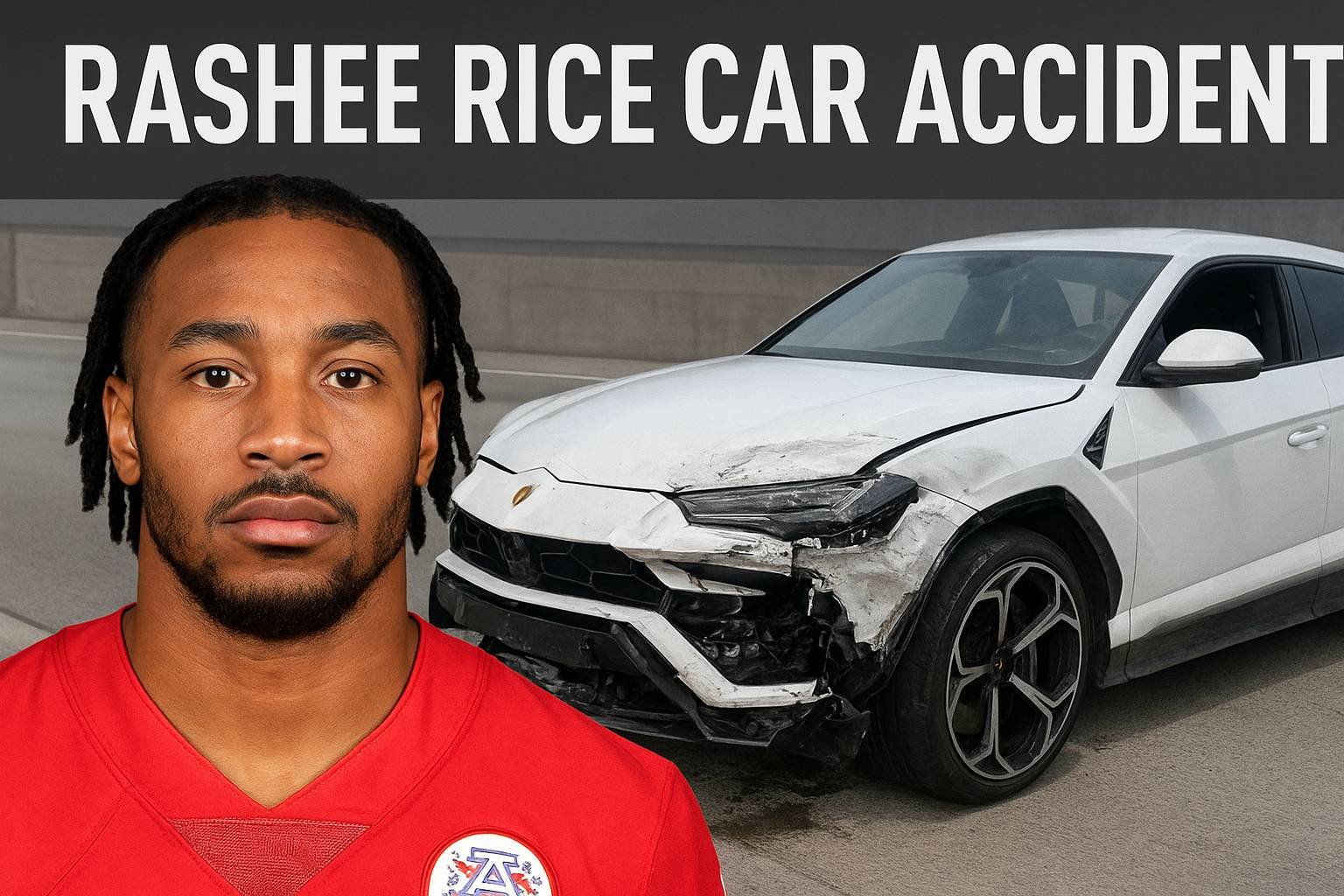
The incident occurred on March 30, 2024, in Dallas, Texas. According to police reports and later confirmed statements, Rice was driving a 2020 Lamborghini Urus SUV at a very high speed — around 119 miles per hour — on a busy expressway called North Central Expressway.
He was reportedly participating in a sort of informal street race with another driver, identified as his then-teammate from SMU, Theodore Knox, who was driving a Chevrolet Corvette.
Speeding at such a high rate, especially on a roadway with a posted limit of 70 mph, is inherently risky. On that afternoon, as Rice maneuvered the Lamborghini aggressively through traffic, he lost control.
The vehicle struck the median — a concrete barrier separating lanes — and triggered a multi-car, chain-reaction collision. Six vehicles were involved in total, and multiple people were hurt. Police reported that at least seven occupants from those cars required medical attention or transport to the hospital.
The crash wasn’t just a single impact. When a high-speed vehicle veers into other lanes, it affects everything around it: surrounding drivers have little time or space to react, and what begins as one collision can rapidly turn into several. That’s exactly what happened here.
Once the vehicles came to a halt, authorities say that Rice and others exited the cars and left the scene on foot, without checking on the welfare of the people in the other vehicles. Leaving the scene of an accident where injuries occurred is considered a serious offense under Texas law.
Initial Police Response and Investigation
After the crash, eyewitness videos and dashcam footage began circulating online — capturing flashes of the collision and multiple cars tangled on the expressway. Media outlets and police started piecing together what happened.
Dallas police eventually issued an arrest warrant for Rice on multiple charges, including:
- Collision involving serious bodily injury
- Racing on the highway causing bodily injury
- Counts related to injuries sustained by other drivers
These are not simple traffic infractions — they are felony-level offenses, meaning they carry potential prison time and significant legal consequences under Texas criminal code.
In those early days after the crash, Rice’s attorney and representatives communicated that he would cooperate with authorities and take responsibility for his part in the collision. Shortly after, Rice turned himself in to the police, and he was briefly detained before release while the legal process unfolded.
Legal Proceedings: Guilty Plea and Sentencing
Almost a year after the crash, in July 2025, Rice reached a plea agreement with prosecutors in Dallas County. He pleaded guilty to two third-degree felonies: collision involving serious bodily injury and racing on a highway causing bodily injury.
This plea deal carried several key components:
- Deferred probation for five years, meaning if Rice complies with the terms, the charges may not become a permanent conviction on his record.
- 30 days of jail time as part of the probation conditions, which he can serve at any point during the probation period.
- Restitution payments requiring him to cover out-of-pocket medical expenses for the victims of the crash, which amounted to over $115,000.
Included in many public statements from his attorney was a remorseful sentiment. Rice expressed his regret, urging others to prioritize safety and to respect speed limits.
He acknowledged his part in the situation and stated he wanted to ensure that everyone affected would be made whole. Legal representatives highlighted that the case was being resolved responsibly.
The probation condition means that while Rice must fulfill certain requirements — such as paying restitution and potentially completing community service or other terms set by the court — he avoids a long prison sentence.
If he successfully completes probation, the felony counts may not remain as lasting convictions, which can have a major impact on his future opportunities.
What Happened to the Victims of the Crash
In the initial crash, vehicles belonging to several motorists were damaged, and individuals were physically hurt. Police and media reports indicated that at least seven people were injured to varying degrees, from minor to more significant wounds requiring hospital treatment.
Neither Rice nor his friend remained at the scene to check on others right after the collision. That aspect — leaving before ensuring the safety of others — contributed to the gravity of the legal charges and was a focus of prosecutors.
The restitution payments made as part of the plea agreement were meant to cover the victims’ medical costs, but the emotional and physical toll of the crash is something not fully captured by numbers.
People involved in these kinds of accidents often face pain, recovery time, and insurance complications long after the initial event.
NFL and Kansas City Chiefs Reactions
The legal fallout naturally had implications beyond courts and hospitals — it reached the professional sport Rice was part of.
Following the announcement of his sentencing and probation, the National Football League (NFL) announced a suspension under its personal-conduct policy, related to the crash. Rice received a six-game suspension from the league, meaning he would miss the start of the Kansas City Chiefs’ season while fulfilling the imposed disciplinary action.
The Chiefs organization issued limited statements, noting that they were aware of developments and that matters remained under review. As is often standard in ongoing legal and disciplinary procedures, teams aim to balance support for their players with acknowledgement of serious off-field issues.
Rice’s absence from the field — first due to knee injury and later due to suspension — changed the Chiefs’ season plans. The wide receiver had been an important part of their offense before the collision, recording notable contributions in his early games before being sidelined due to injury.
Speed, Risk, and Responsibility: Broader Lessons
As someone who writes about automotive topics often, the Rice accident forced me to think about a bigger point — not just who was involved or what the legal outcome was, but what this tells us about speed, personal responsibility, and how easily things can go wrong in a matter of seconds.
Driving at 119 mph on a busy expressway is dangerous not just in theory but in real life. At those speeds, stopping distances are vastly longer, reaction times are compressed, and even small steering inputs can have dramatic results. When traffic is on the road, any high-speed maneuver puts everyone else at risk.
Part of what made this crash especially serious was not just the speed, but the mismatch between that behavior and the normal flow of traffic. Multiple vehicles became part of a chain reaction. And beyond that, the decision to leave the scene compounded the legal consequences.
Traffic safety is something that affects us all, regardless of our profession or status. Whether you’re driving a regular car or a high-performance vehicle like a Lamborghini, understanding the limits of control and respecting speed limits isn’t just about avoiding tickets — it’s about protecting lives.
Public and Media Reactions
Public reaction to the incident was mixed, as often happens when an athlete or celebrity is involved in an off-field legal issue. Some commentators focused on the need for accountability and criticized the initial behavior and decision to leave the scene.
Others pointed to law enforcement and legal processes, emphasizing due process and eventual restitution made to victims.
The media coverage over months touched on many aspects — from the legal proceedings to possible insurance implications to how the Chiefs might adjust their roster without Rice for the start of the season.
Articles and statements from prosecutors, attorneys, and team representatives added context to what was a complex situation affecting multiple parties.
How This Impacts Rashee Rice’s Future
A situation like this has both short-term and long-term implications for anyone, especially someone in the public eye.
In the short term, Rice will have to serve his probation and the jail time as specified by the court — albeit within the probation period rather than immediately behind bars. He also will miss games due to the NFL suspension tied to personal conduct policies.
In the long term, the probation means adhering to strict terms for five years, and fulfilling all conditions to avoid a lasting conviction on his record. The legal consequences may also affect endorsements, team decisions, and the way fans and media view his career.
At the same time, Rice has publicly acknowledged the consequences of his actions, expressed regret, and said he hopes to be an example of learning from mistakes. For some, that public accountability matters. For others, the focus is on ensuring safety and responsibility on the road.
Final Reflections
When we first looked into the Rashee Rice car accident, we approached it like any automotive or legal topic — trying to understand the facts, separate emotion from reality, and present a clear timeline of events.
It’s about how split-second decisions behind the wheel can ripple outward and affect many lives. It’s about how public figures are held to scrutiny from courts, leagues, and the public. And it’s about how someone’s choices — whether in traffic or elsewhere — have consequences that reach far beyond a single moment.
For drivers of all kinds, this incident underscores a simple truth: the road doesn’t forgive mistakes easily, and the people around us are real individuals with families and lives.
Accidents happen, but when they are caused by risky behavior, the responsibility to repair harm and learn from the outcome becomes even more important.
By understanding the Rashee Rice crash and everything that followed — from police reports to plea agreements to NFL action — we gain a clearer picture of how such incidents are handled in our legal systems, and how accountability plays out when someone in the spotlight is involved.